Math 12 – Precalculus – fall ’04 – Chapter 5 Test Solutions.
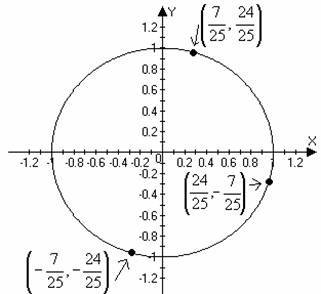
1. Suppose a terminal point determined by t is the point .
|
a. Verify
that the point lies on the unit circle. b. What
are the coordinates of the terminal point for ? This is the point a half circumference
farther along the circle: . c. What are the coordinates of the terminal point for ? This is the point a quarter circumference farther along the circle: . |
|
2. Suppose a terminal point determined by t is P(x,y) on the unit circle, where .
a. What
quadrants could P be in?
SOLN: P could be in either quadrant II or quadrant IV.
b. What
are the absolute values of the coordinates of x and y ?
SOLN: Plugging into the Pythagorean
identity, so that and thus .
c. Find
absolute values for csc(t), and cot(t).
SOLN:
3. Suppose a terminal point P(x,y) in QIV on the unit circle has y-coordinate . Find
a. SOLN:
b. SOLN:
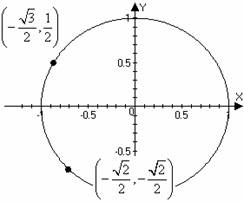
4. Find the reference number for each and plot its position on the unit circle together with exact values for its x and y coordinates.
|
a. so that and b. where |
|
|
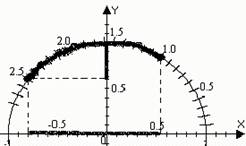
5.
Suppose that . Estimate the corresponding intervals for
the values of cos(t) and sin(t) and
highlight these on the diagram: |
|
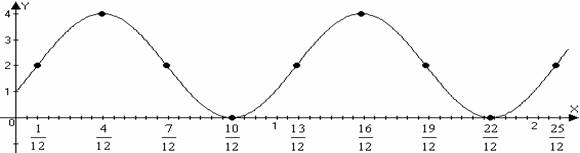
6.
Find the amplitude, period and phase shift of the and sketch a graph showing at least one wave
form. Be careful scale and label axes in
your graph.
SOLN: Amplitude = 2. Period = 1 and
phase shift is 1/12.
7.
Find the period and at least two asymptotes and graph
the function .
SOLN: The period is and the asymptotes are where
8.
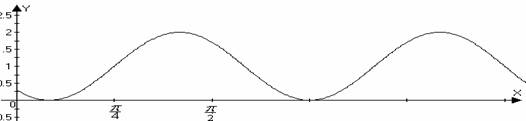
Find sinusoidal formula which fits the graph shown
below:
SOLN: Amplitude = 1. Phase angle = . Period =