Math 12 – Chapter 3 Test Solutions – Fall ’04.
1. Consider the polynomial . In descending powers,
a. What sequence of transformations (shifts/shrinks) will transform f to ? SOLN:
i.
Shift 8 units down and two units right: .
These can be done in any order or simultaneously.
ii.
Expand vertically by a factor of 4 and reflect in the x-axis.  . Again, do these in either order.
b.
Apply the leading term test and describe the long-term
behavior of this function.
SOLN: Since the leading coefficient is
negative and the degree is odd,
as and as  .
.
c. Choose
an appropriate value of k so that satisfies the conditions of the rational zeros
theorem. Then, write the possible
rational zeros of f(x) which follow from the conclusion of
the theorem.
SOLN: If k = 4 then has integer coefficients and so satisfies the
conditions of the rational zeros theorem.
The set of possible rational zeros are divisors of 80: {±1, ±2, ±4, ±5, ±8,
±10, ±16, ±20, ±40, ±80}.
2. Consider
a.
What does Descartes’ rule of signs say about the number
of pos, & neg. zeros for p?
SOLN: Descartes rule of signs says there
are either 3 or 1 positive roots
and exactly 1 negative root.
|
2 |
-9 |
63 |
-89 |
-7 |
10 |
|
|
|
-18 |
90 |
2 |
-10 |
|
|
-9 |
45 |
1 |
-5 |
0 |
b. Use synthetic division to find the quotient and remainder when is divided by .
So the remainder is 0 and the quotient is
c.
Relate the dividend, divisor, quotient and remainder of
part (b) in an equation.

3. Consider
a. If
x = 2i is a zero, what irreducible quadratic factor does p have?
SOLN:
b. Find the rational root of p and write p as a product of linear and irreducible quadratic factors. SOLN : The possible rational roots of p are many, but checking x = 1 we see that not only is that an upper bound on the roots but there is a root between x = 0 and x = 1. Guessing ½ leads to a remainder of -15/4 (see table), which, by the intermediate value theorem, suggests that the root is between ½ and 1, probably closer to ½. This suggests the smallest possible root larger than ½, which is 7/12—which turns out to be a root! Note that we could have found this by doing long division by . Either way, we get . You can also get this result by “factoring by grouping.” . |
4. Let
a.
List all possible rational zeros, according to the
theorem on rational zeros.
SOLN: The possible rational zeros are .
b. Use a combination of the rational roots theorem, synthetic division and the theorem on bounds to show that has no rational roots.
|
SOLN: The synthetic division table at right shows the results of doing synthetic division to find the quotient and remainder for divisions by all possible x – r from an upper bound on the roots down to a lower bound (using the theorem on bounds.) Since none have a remainders of zero, none of the x – r are divisors and p has no rational root. |
To
look more closely—there are two irrational real roots and a pair of complex
conjugate roots with irrational real and imaginary parts. The software Maple represents the real part
of the complex roots like so: 
5. Let .
a.
Use the theorem on bounds to explain why is an upper bound on the zeros of .
SOLN: Division by x – 2 produces the relation, . This shows that if x is bigger that 2 then p
is 27 more than the product of positive numbers, so there can be no zeros of p bigger than 2.
b.
Use the fact that is a factor of to find all roots.
SOLN: Doing long division:
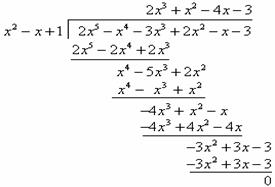
we find that .
Factoring further: . Thus the roots are at .
|
6.
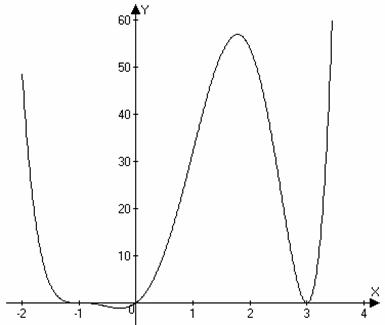
Sketch a graph of
showing how it passes through all
intercepts. |
|
7.
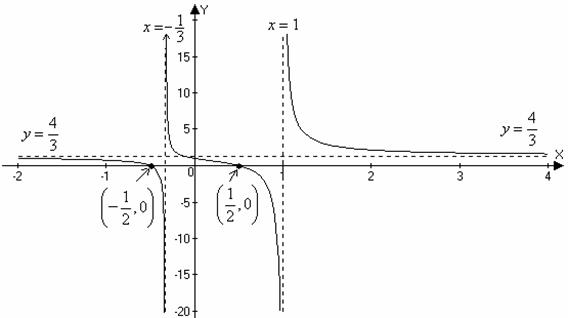
Sketch a graph for the rational function showing all intercepts and asymptotes. State what the intercepts and asymptotes are.
SOLN: has intercepts at and (1,0).
The vertical asymptotes are along and . The horizontal asymptote is along .