|
|
Intermediate Algebra Syllabus -- Fall '04
Instructor: Geoff Hagopian
Email: ghagopian@collegeofthedesert.edu,
Web page: http://faculty.collegeofthedesert.edu/ghagopian/
PHONE:
COURSE DESCRIPTION: Intermediate Algebra is a second semester study of basic methods in algebra with an emphasis on modeling and problem solving. A common thread through this is course is the idea that any problem in basic algebra can be addressed through the use of
(1) relations between expression using operations on numbers and variables.
(2) tabulated data
(3) visual displays (graphs)
As an example of how these three approaches may work together, consider the inequality
which says that the sum of squares on variables x and y is less than or equal to 1.
We can tabulate values for x, y, x2,
y2, and x2 + y2g to help determine x, y pairs where the inequality
is true:
|
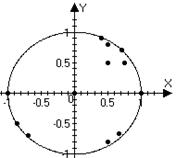
Plotting the x, y pairs, you may observe they all lie on or inside a circle of radius 1, centered at the origin. This may then lead you to conjecture that the solutions to the inequality are all point within a distance of 1 from the origin. How could you prove this conjecture? |
|
INTERMEDIEATE ALGEBRA TOPICS:
§ systems of linear and quadratic equations in several variables
§ functions
§ polynomials
§ roots and powers
§ exponential/logarithmic relations
§ conics
TEXTBOOK: Modeling, Functions, and Graphs by Yoshiwara. Emphasis in this text is on using basic algebra for mathematical modeling and problem solving. We will not be able to cover every problem type or every approach during class, but you will be responsible for everything discussed in the text.
LECTURE/HOMEWORK/
EXAMS: There will be 7 chapter tests (see schedule) and a cumulative final exam. It is important to understand that the point of these exams is to test your understanding of the concepts covered; that is, they will not necessarily consist entirely of cookie-cutter problems exactly like ones you’ve already seen, but may involve novel problems testing your understanding of how to use basic principles of calculus in context.
TECHNOLOGY: A scientific calculator is required for this course. Though the text book devotes a large amount of material to using a graphing calculator, a graphing calculator is not required for this class. Whenever textbook problems request the use a graphing calculator (as is often the case), use pencil and paper instead.
ATTENDANCE: You are required to attend all lecture and lab sessions: 12 hours per week for 8 weeks: a total of 96 hours. The two most significant indicators for success in this course are attendance and completion of the homework. If you're not there doing what it is that defines the class, you missed it.
GRADE: Your grade in this class will be a weighted average of your attendance, homework quiz, chapter test and final exam scores, using the following apportionment:
Attendance:
10 pts.
Homework quiz: 10 pts.
Chapter tests: 50 pts.
Final Exam: 30 pts.