Math 1B Chapter 7 Test
fall ’06 Name________________________
Show your work for credit. Write responses on separate paper. Do not abuse a calculator.
1. Suppose
a quantity P satisfies the differential equation .
a. Find
the equilibrium solutions for P and classify each as either stable or
unstable.
b. At
what value of P is P increasing most rapidly?
2. Consider
the initial value problem .
a. Solve
for x as a function of t using the method of separating variables.
Note: You may need to use integration by parts.
If you do, show the table of u,v,du,dv expressions. Do not rely on a calculator to get the
result.
b. Use
Euler’s method with a step size of 0.25 to get a numerical approximation for . Show your calculations by completing the
table below:
3. Consider
the family of functions defined by . Find the family of orthogonal trajectories.
|
year |
Population |
|
1960 |
11209160 |
|
1970 |
14598316 |
|
1980 |
17848320 |
|
1990 |
20278957 |
|
2000 |
22191087 |
|
2005 |
23070170 |
4. Consider
the table below which tabulates the population of
a. Fit
a natural growth model to the populations in years 1960 and 1970. How well does the model predict the projected
population for 2005?
b. It
appears the growth rate may have reached a maximum in the year 1970. Assuming that is true, write a logistic
differential equation for the population of
5. Solve
the initial value problem: .
6. Suppose
that a spherical raindrop is evaporating as it falls so that its mass is
decreasing at a rate proportional to its surface area. That is, . Substitute
(where
is the mass density of water and r is
the radius of the spherical raindrop) to show that
.
7. Human
and mosquito populations in a swampy equatorial environment are modeled by the
system of differential equations,
.
a. Combine
these equations to get a separable differential equation in M and H and Show that there exists a constant A such that . What is the value of A if at some time
there are 10 humans and 1000 mosquitos?
b. Is
one or the other of these population dependent upon the other for their
survival?
Why or why not?
Math 1B Chapter 7 Test Solutions
fall ’06
1.
Suppose a quantity P satisfies the differential
equation .
a.
Find the equilibrium solutions for P and
classify each as either stable or unstable.
The zero at is unstable.
The zero at P = 100 is
stable.
b.
At what value of P
is P increasing most rapidly?
The maximum for occurs at the vertex, which is halfway between
the two zeros:
2.
Consider the initial value problem .
a.
Solve for x as a function of t using the method
of separating variables.
It’s interesting to compare this result with the TI-89 result:
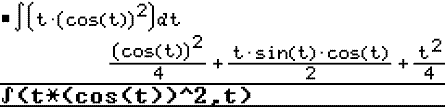
and verify that they differ by a constant.
Do determine the constant will satisfy the initial condition, plug in t = 0
and x = :
. Now, solving for x we have
b.
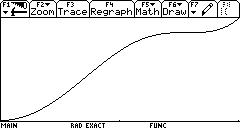
Use Euler’s method with a step size of 0.25 to get a
numerical approximation for . Show your calculations by completing the
table below:
- Consider
the family of functions defined by . Find the family of orthogonal trajectories.
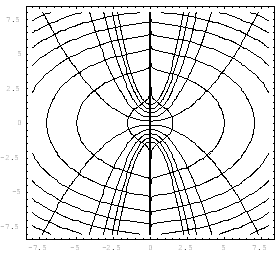
means that for the orthogonal trajectory,. Now, in the original equation,. Substituting this into the equation for the orthogonal trajectory we can solve for y by separating variables:
In Mathematica, you could draw these curves like so:
![fam[x_, c_] = c * (1 + x^2) fam2[x_, k_] = Sqrt[k - x^2/2 - Log[Abs[x]]] fam3[x_, n_] = - Sqrt[n - x^2/2 - Log[Abs[x]]]](../../../classes/m1b/HTMLFiles/otraj01_1.gif)
|
|
|
![RowBox[{RowBox[{Plot, [, RowBox[{RowBox[{{, RowBox[{RowBox[{fam, [, RowBox[{x, ,, , 0.01}], ] ... 0], RGBColor[1, 0, 0], RGBColor[1, 0, 0], RGBColor[1, 0, 0], RGBColor[1, 0, 0]}}], ]}], }]](../../../classes/m1b/HTMLFiles/otraj01_5.gif)
![[Graphics:HTMLFiles/otraj01_10.gif]](../../../classes/m1b/HTMLFiles/otraj01_10.gif)
To be sure, this may not be the best approach to plotting
the orthogonal trajectories. In
Multivariate Calculus (Math 2A at COD) you’ll learn about contour plots. Here are the commands for using contour plots
to show these orthogonal trajectories:
|
c1 = ContourPlot[y/(1+x^2),
|
|
|
year |
Population |
|
1960 |
11209160 |
|
1970 |
14598316 |
|
1980 |
17848320 |
|
1990 |
20278957 |
|
2000 |
22191087 |
|
2005 |
23070170 |
4.
Consider the table below which tabulates the population
of
a.
Fit a natural growth model to the populations in years
1960 and 1970. How well does the model
predict the projected population for 2005?
Let t be the years since 1960 then . To find r, plug in the 1970 data:
Thus,
b.
It appears the growth rate may have reached a maximum
in the year 1970. Assuming that is true,
write a logistic differential equation for the population of
If is maximal in 1970, then the carrying capacity
would be 2*(14598316) = 29196632 and the logistic model would look like this
- forgive the over-stated accuracy. We’ll round to three digits so as not to
seem utterly ridiculous. This ODE is solved
by separating variables in the usual way:
. At this stage we say that when t = 0,
. Solving for P yields
It remains to approximate r. We have 4 data after 1870 we could use. How about the most distant? When t = 45 (2005) we have So
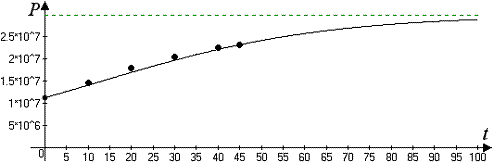
Below is a plot of this function over the
tabulated data.
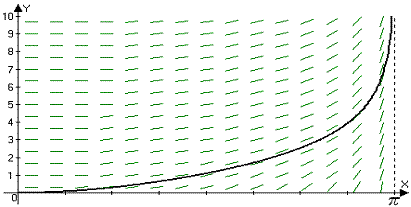
- Solve
the initial value problem: .
where u = 1 + sin x . Substituting v = ey + 1 in the first yields the following:
. This is as good a time as any to π impose the initial conditions and solve for c:. Thus,
- Suppose
that a spherical raindrop is evaporating as it falls so that its mass is
decreasing at a rate proportional to its surface area. That is, . Substitute(whereis the mass density of water and r is the radius of the spherical raindrop) to show that.
Substitutingintoyields
7.
Human and mosquito populations in a swampy equatorial
environment are modeled by the system of differential equations,
.
a.
Separating variables:
If H = 10, M = 1000,
b. According to the model, in the absence of mosquitoes the human population will grow at a relative growth rate of 1%, while the mosquitoes, in the absence of humans will grow at a relative growth rate of 20% - go mosquitoes!
As an afterthought, one might be interested in how to plot the solution curves for various initial populations. In Mathematica, you could use the ImplicitPlot feature in the Graphics subdirectory of the StandardPackages in Addons. To do this, you type (note “`” back single quote usage on “~” key):
<<Graphics`
After quite a bit of fiddling, I arrived at the following command that plots
part of the solution curve for this problem:
ImplicitPlot[(x*Exp[-0.002*x])/(y^20*Exp[0.04*y^2])
→ 2.47875*^-20,{x,1,8000},{y,1,30}, PlotRegion → {{0,1},{0,1}},AspectRatio →
.618, AspectRatioFixed → False]
This
produces the graph below:
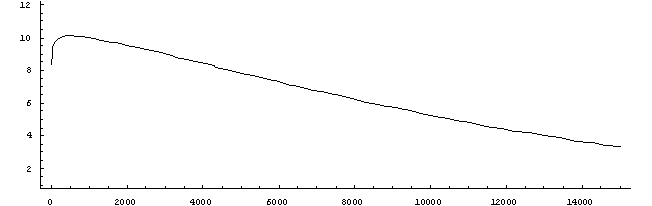
Looks like the mosquitoes thrive and the people dwindle.