Math 1A – Final Exam – Fall ’04
|
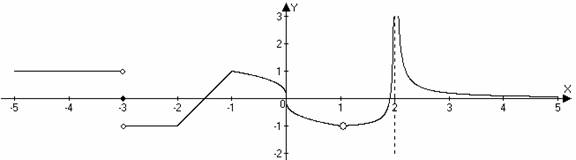
1. The graph below shows y = f(x). a. State, with reasons, the numbers a at which does not exist. b. State where the function is discontinuous and classify the discontinuity as removable, jump or asymptote. c. State, with reasons, the numbers at which the function is not differentiable. |
|
|
2.
Suppose f(x)
is a function such that for all x >
0, .
What is ? Why?
3.
Sketch a graph for a function that meets the given
conditions:
|
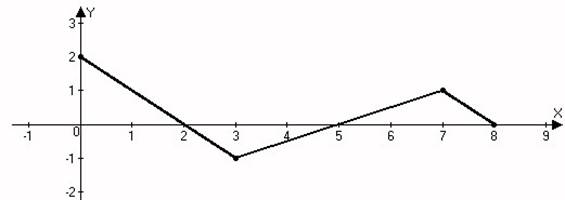
4. The graph of is shown below. a. Sketch a graph for . b. Sketch a possible graph for . |
|
|
5.
Find a linear approximation for the function at a
= 0 and use it to approximate .
6.
Find the slope of the line tangent to the curve at .
7.
Find an equation for the line tangent to at .
8.
At what point on the curve is the tangent line horizontal?
9.
Find the local and global extreme values of the
function on the interval [-1,2].
10. Find
the point on the hyperbola xy = 16
that is closest to the point (4,0).
11. Evaluate
the limit: .
12. The
velocity of a wave of length L in
deep water is where k
and C are known positive
constants. What is the length of the
wave that gives the minimum velocity?
13. What is the maximum slope of a line connecting the origin (0,0) with a point on the parabola ?
14. Show
that the y-coordinate of the point (x,y)
on the curve described by  that
is closest to the point (0,2) can be found by solving
that
is closest to the point (0,2) can be found by solving  .
Use
.
Use
|
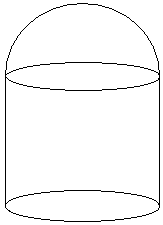
15. A
metal storage tank with volume V is
to be constructed in the shape of a right circular cylinder with a
hemispherical top. What radius and
height will require the least amount of metal? |
|