Math 1A – Chapter 3 Test Solutions – Fall ’04
1. Use the definition of the derivative to compute each of the following limits. Follow the form of this example:
a.
b.
c.
2.
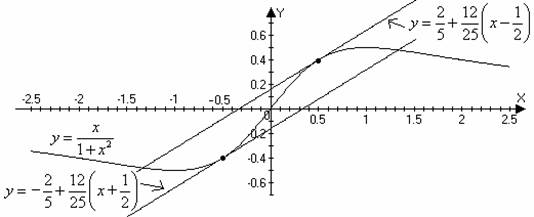
Find equations of the lines tangent to the curve which are parallel to the line . Sketch a graph illustrating these tangencies.
SOLN: Using the quotient rule, . We seek a place where the slope is 0.48, so
we set about solving
When ,
so the tangent lines are given by
3.
a. Find
dF/dr and write a sentence of two explaining what that means.
SOLN: is the rate of change in the force of
gravitational attraction per change in distance between the masses. Note that dF/dr
is negative so F decreases as r increases and that the rate of change
is inversely proportional to the cube of r.
b. Suppose
that planet Xorkon attracts an object with a force that decreases at a
rate of 3 N/km when r = 10,000
km. How fast does the force change when r = 5000 km?
SOLN: ,
thus when r = 5000,
4.
Use the definition
of the derivative to simplify .
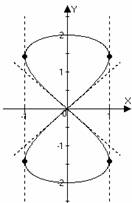
5. A curve C is defined by the parametric equations .
a.
Show that C
has two tangent lines at the origin: and find their equations.
SOLN: C passes through the origin when . The slopes of the tangent lines are
Thus the tangent lines are y = x and y = –x.
|
b.
Find the points where the tangent line in the x-y plane is vertical. SOLN: The tangent line will be vertical when . |
|
6.
Find an equation for the line tangent to at (1,1).
SOLN: Assuming that y is a function of x,
apply the differential operator to get . Plugging in (1,1), and solving for dy/dx, ,
so the equation for the tangent line is y
= 2 – x. In fact, the solution set includes the
coordinate axes (x = 0 and y = 0) and the line y = 2 – x.
7. Let .
a.
Find the differential dy.
SOLN:
b.
Evaluate dy
and if x
= 8 and dx = = 0.1
SOLN: .
c.
Estimate using the line tangent to at (8,2).
What is the relative error in your estimation?
SOLN: . The relative error is an overestimation of
8.
Find the derivative of the function by first differentiating .
SOLN: . So .