Math 1A – Calculus – Chapter 3 Test II - solutions.
1. Consider .
a.
Simplify formulas for the first and second derivatives
of f(r).
SOLN: and
b.
Find the inflection point for f(r).
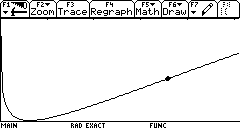
SOLN: where
Note that the change in concavity is barely discernable in the graph:
2.
Find equations for the tangent lines to that are parallel to the line .
SOLN: ,
so the slope of the tangent line is parallel to the given line where Thus the equations for the tangent lines are and .

3.
In a fish farm, a population of the fish is introduced
into a pond and harvested regularly. A
model for the rate of change of the fish population is given by the equation
where r0 is the birth rate
of the fish, Pmax is the maximum population the pond can sustain and
H is proportion of fish harvested in
a year. If the pond can sustain a
maximum population of 5,000 fish, the birth rate is 4% and the harvesting rate
is 2%, what (non-zero) population level(s) will not change, according to the
model?
SOLN: The population will not change
when . Plugging in the parameter values, so either P
= 0 or .
4.
Use the definition of the derivative to compute
SOLN: .a
5.
Show that the curve described by the parametric
equations
has two tangent lines where x = 1/2
and find their equations.
SOLN: x = ½ means that where .
With k = 0, . . At ,
,
so the tangent line is . At ,
,
so the tangent line is . 
6.
If ,
find a formula for using implicit differentiation.
SOLN:
7.
Use logarithmic differentiation to find the derivative
of
SOLN:
8.
Verify the given linearization at a
= 0. Then determine the values of x for which the linear approximation is
accurate to within 0.1.
SOLN: Near x = 0, . Find where the error in approximation is no
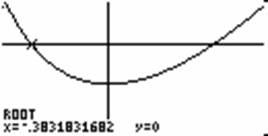
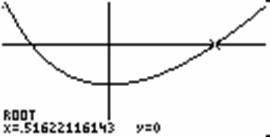
more than 0.1, solve . These numbers can be easily found using, say,
a TI85 calculator, to find the roots of
y1=abs(x-ln(abs(x+1)))-0.1: