Math 1A – Chapter 4 Test II Solutions – Fall ’04.
|
1.
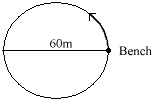
Blanca is running around a circular track of radius r = 30 meters at a speed of 3
meters/sec. Recall that the linear
speed v is related to the angular
speed ω by v = ωr. a.
What is Blanca’s angular velocity, ω? |
|
|
b.
Recall that Blanca’s position at time t can be modeled by the parametric equations . If Blanca starts at a bench on the east
side of the track and heads north around the track, what is a
parameterization of her position at time t? c.
Write a formula for the d.
Find the rate of change of Blanca’s distance from the
bench when t = 1. |
|
|
2.
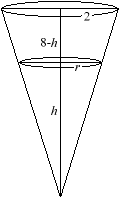
A paper cup has the shape of a cone with height 8 cm
and radius 2 cm (at the top). If water
is poured into the cup at a rate of 2 cm3/s, how fast is the water
level rising when the water is 6 cm deep? |
|
|
3.
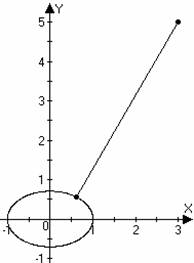
Find the point on the ellipse which is closest to the point (3,5). |
|
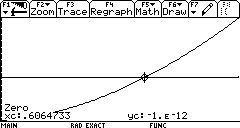
Using the Voyage 200 to plot this function on
the interval [0,1] and to find its root, we have (as shown in the graphic) x = 0.6064733. This corresponds to the point (0.606,0.562)
on the ellipse.
|
4.
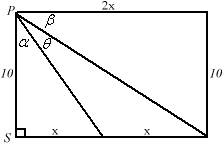
An observer stands at a point P, 10 meters above a track.
Two runners start at a point S in the figure and run along the
track. One runner runs twice as fast
as the other. Find the maximum value
of the observer’s angle of sight θ
between the runners. |
|
|
that the sum of the angles is . It’s easy to see that and so that . Differentiating and setting , . Thus . You can avoid using β by looking at whence . Differentiating, ,
we have |
|
5.
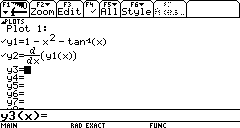
Use
SOLN: The function is zero when the equation is true.
On a programmable calculator, you can write a program to do

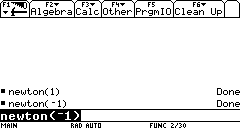
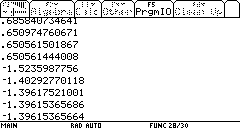
This indicates that there are two solutions.
If the initial value is –1, the method converges to
–1.139615365664, while the initial value 1 leads to 0.650561444008
6. Consider
a.
Explain why g satisfies
the conditions of the mean value theorem on .
SOLN: Since g is a product of a
differentiable function with a composition of differentiable functions, it is
differentiable everywhere—in particular, it is differentiable on .
b.
Set up an equation to find the point(s) in which, by the mean value theorem are
guaranteed to exist.
SOLN:
c.
Use
SOLN: A solution to the equation is a
zero of .
Again, the Voyage 200 will get the job done. Note that the program has been
modified to exit if the difference in iterates is just small rather than 0:

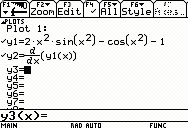
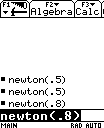
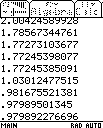
So with the initial value x1
= 0.5 the iterates converge to 1.77245385091 (which so happens to be the right
endpoint of …not on the interior. With the initial value x1 = 0.8 however, we get one
of the two values whose existence is guaranteed by the theorem: approximately
0.9798922767