Math 1A – Chapter 2 Test II Solutions – Fall ’04
1.
The graph of f is given.
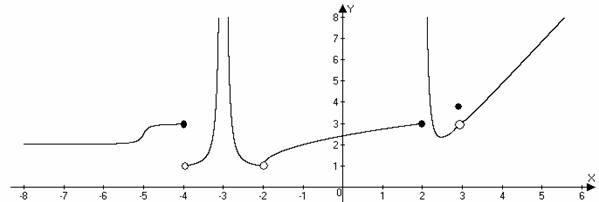
a. Find each limit, or explain why it doesn’t exist:
|
i. |
ii. |
iii. doesn’t exist. |
|
iv. |
v. |
vi. |
b. Where
does the function have removable discontinuities?
c. Where
does the function have a jump discontinuity?
2. Find the limit
|
a. |
b. |
|
c. |
d. |
3.
Use the
intermediate value theorem to prove that
has a solution in (-1,0).
SOLN: Consider . Since f
is a sum of continuous functions, it is continuous. Also 0 is between and so by the Intermediate Value Theorem, there is
such that f(c) = 0, which is a solution to given
equation.
4.
If the tangent to y
= f(x) at (5,4) passes through the point (1,2), find f(5) and .
SOLN: f(5) = 4 is given. The slope of the tangent line is
5.
Find the derivative of using the definition of the derivative.
SOLN: One way is to plug directly into
the formula for the limit of a difference quotient:
Alternatively, it’s a bit simpler to do division to write and then plug into the difference quotient:
6. Suppose that we don’t have a formula for g(x) but we know that g(2) = -4 and for all x.
a. Use
a linear approximation to estimate g(1.95)
and g(2.05).
SOLN: Using the line tangent to g(x)
at x = 2, that is, we have and
b. Are
your estimates in part (a) too large or too small? Explain.
SOLN: Since is increasing, g(x) is concave up and so
the tangent line lies beneath the curve.
Therefore both estimates are underestimates.
7.
Is there a number a
such that exists?
If not, why not? If so, find the
value of a and the value of the
limit.
SOLN: can
exist only if the numerator goes to zero at -2.
That is . If a
= 8 then
8. Consider .
a.
What theorem is essential to evaluating this
limit. Why are the conditions of the
theorem met?
SOLN: The relevant theorem says that
if (i.e. the limit exists) and if f is continuous at b (i.e. ) then . Since is a composition of continuous functions, it
is also continuous, thus the conditions of theorem are met.
b.
Use the theorem to evaluate the limit.
SOLN:
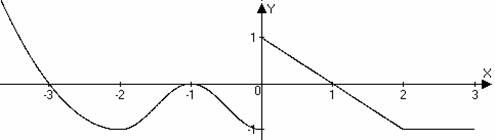
9. For the function whose derivative function is graphed below,
a. is increasing on
b. is concave up on (–2,1)
c. has a local maximum where x = -3 and where x = 1.
d. is positive on (–2,1)
e. where x
= –2 and where x = –1.