Math 5 Trigonometry
Chapter 5 Test Solutions
fall ’06
1.
What is the length of the arc subtended by an angle in a circle of radius 14?
SOLN:
2.
Find the central angle on a circle of radius 4 that
subtends and arc of length 6. Give both
the radian measure and the degree measure of the angle.
SOLN:
3.
What is the radius of a circle where a sector with
central angle of 36˚ has area = 9?
SOLN: 36˚ = ,
so we solve
|
4.
Three circles with radii 3, 5 and 12 are externally
tangent to one another, as shown in the figure at right. a.
Show that b.
Approximate to the nearest hundredth of a degree
measures for c. Find the area of the shaded region between the three circles. |
|
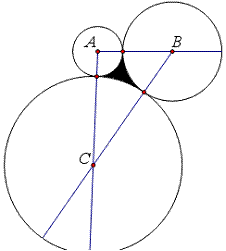
SOLN:
Area of triangle minus areas of sectors
5. A tricycle with little wheels of diameter 10cm and a big wheel with diameter 40cm is rolling along so that the big wheel is rolling at 35 rotations per minute.
a.
What is the angular speed of the little wheels?
SOLN: The angular speed of the little
wheel is
b.
What is the linear speed of the tricycle?
|
6.
The elongation α for Mercury is the angle formed by
the planet, Earth and Sun, as shown in the diagram at right. Assume the distance from Mercury to the sun
is 0.387 AU (38.7% of the distance from Earth to Sun) and that α = 18˚. Find the possible distances from Earth to
Mercury. |
|
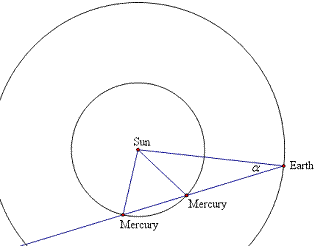
This means the sun to earth distance can be either or
|
7.
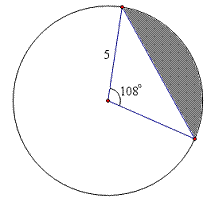
Find the area of the shaded region in the figure at
right. 8.
By the law of cosines, the largest angle is |
|
By the law of sines, the smallest
angle is
That means the third angle is 180˚ 41.4˚
82.8˚ = 57.8˚
9.
By the law of cosines,
10.
The vectors are perpendicular and have equal lengths,
so the sum and difference have the same value:
11.
(This is a problem from the text in the section on law
of sines) 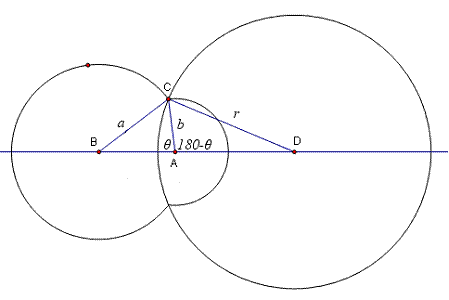
In the picture, we can see that, since ,
in triangle
and in triangle
. Also,
since
in the big triangle BCD, we have
. Thus
(1.1)
Applying the law of sines again in triangle Substituting this into (1.1) we get
 , from which the result follows:
 .