Trigonometry Chapter 4 Test Solutions
Fall ‘06
1.
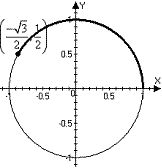
For arclength extending counterclockwise along the unit
circle from (1,0)
|
a.
The reference number for t is b.
The coordinates of the terminal point P(x,y) are then c. The diagram at right illustrates this point’s position on a plot of the unit circle. |
|
|
2.
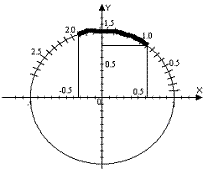
Suppose a.
If b.
If |
|
|
3.
In the diagram, P
is the terminal point for a.
Since the directed arc from A to Q, b.
The coordinates of Q are (x, c.
|
|
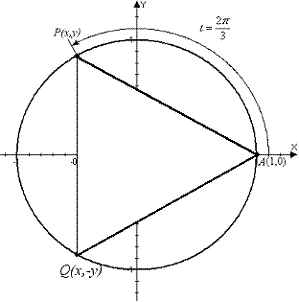
d.
Since (x,y) is on the unit circle, and we can to substitute for y to get
. Expand, collect and get zero on one side:
,
which is factorable:
e.
If x = 1/2
then y =
.
- implies
- In
quadrant II
- The
amplitude, period and phase shift of is 2, the period isand the phase shift is -1/16. Here’s a graph showing two periods.
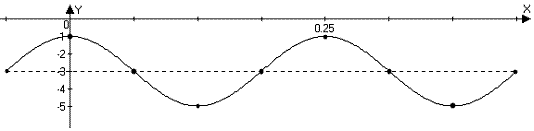
- The
sinusoid shown below has y
values ranging from -1 to 5 so the line of equilibrium is y = 2 and the amplitude is 3. There’s a peak at x = -1 and the next is at x
= 7, so the period is 8. The wave
is at equilibrium at x = 5 so
the phase shift is -3. Thus the
sinusoid can be expressed either as a sine or a cosine:

8.
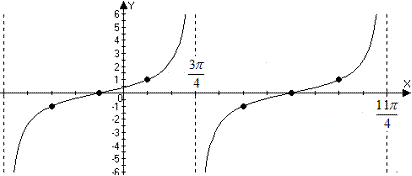
Consider the function .
a.
Vertical asymptotes can be found by solving where k
is any integer:
,
whence adjacent asymptotes can be found by plugging in, say, k = 0 and k = 1:
b.
The distance between asymptotes is one wavelength, so
we add a quarter wavelength to the first asymptote three times to get . Thus the points to plot are
|
c. The graph at right shows how the function passes through the three points and approaches the vertical asymptotes. |
|
9.
Suppose sin t
= 3/5 and t is in the first
quadrant. Find the following:
a. b.
c.